LET’S BE THERE: UNICEF AUSTRALIA’S WORK IS NOT JUST THERE FOR EMERGENCY

More than the urgent help, UNICEF Australia emphasises their continuous commitment toward children.
Background situation
Children's humanitarian remains a continuous urgency in global issues. As recorded in the Humanitarian crisis regarding children and their protection in 2025-2026, the Alliance recorded that more than 500 million children – around one in five worldwide – live in or close to armed conflict and violence. The sources also claim that it creates a disruption for critical services due to psychological support, finance, programmes for children associated with armed forces and armed groups and case management. This creates such issues for children safety: dangers and injuries, maltreatment, family seperation, armed forces and group recruitment, sexual and gender-based violence, mental health and psychological distress and child labour
Understanding the urgency of the problem, UNICEF has also conducted its research on the issue. In 2026, the organisation estimated that more than 200 million children will require humanitarian assistance in 133 countries and territories. Major issues are recorded across regions namely Yemen, Sudan, Haiti, Lebanon, Syria, Myanmar, Democratic Republic of Congo (DRC), Afghanistan.
The insight
Apart from UNICEF, there have been several international child advocacy organisations working. Notable competitors of UNICEF can be counted as Save the Children, ChildFund, Plan International. However, each organisation has its different positioning. Save the Children put themselves in a strong donation base with active call to action with a clear mid term strategy for the organisation vision. Meanwhile, Childfund positioned it as an independent international development organisation working in reducing poverty for children in many disadvantaged communities with leadership clarity. Apart from Childfund and UNICEF, Plan International is also a child advocacy and a sponsor-based organisation – a model that puts a child at the centre, and remains the core of what we do.
Organisation positioning is a key term emergency relief to long-term development solution and advocacy, providing children and young people with the foundation they need to thrive. Historically speaking, UNICEF has been the world’s leading children’s charity since 1946 with the largest help to save children's lives with $61 million raised from the organisation to help children in need in 2024. Additionally, the organisation also has 762,000 project participants across the 35 priority programs benefit for international development programs. Financial clarity: 100% donor funded.
However, UNICEF has its own key distinguishing characteristics that they benefit from. Being an UN based organization with a structured and independent funding activity, it has positioned itself as the largest donor and saving children in the world with wide regional activity. Financial activity comes from the regular monthly donations from the growing community of Global Parents in Australia reaching out every month. This creates the trust
The organisation perception in Australia is generally positive. A research from Nate Henderson indicated that the Australian public has a generalised trust in UNICEF and expected that its Australian office would simply seek to maintain the status quo. However, their research also indicated that UNICEF staff believed their job was not simply to maintain a positive generalized trust with the public but also seek to strengthen it. The study data showed that 71,5% of Australians are familiar or somewhat familiar with UNICEF where 7% of people were not familiar or had never heard of UNICEF and 21.5%. The survey results support this assertion, with 70% of those who said Australia’s influence in Asia-Pacific was high, also ranking UNICEF as effective. While the relationship UNICEF has with the Australian public is a primary reason for Australian Government partnership, the organisation sees the continuous need of improving the awareness of such issues.
Strategy
This insight motivated UNICEF to make a clearer move of positioning. Libby Hodgson shared with Campaign Brief that: “Let’s be there’s mark an important evolution for UNICEF Australia. We’re building on the trust we’ve earned in emergencies, while showing the full breadth of our work – from safe births and health care to education, nutrition and long-term systems-building. Because being there for children isn’t just about responding to a crisis, it’s about consistency and showing up everyday” Therefore, the commitment makes the brand strengthen their actual position as a purposeful international child advocacy organisation.
The new brand platform reflects a deeper mission to its customer to ensure childhood isn’t shaped by crisis but also by constant help. This creates the deeper reason for invitation for all Australians to stand with UNICEF long after the headlines fade as the campaign also helps the public to reshape their awareness about the importance of child development. Therefore, it will eventually allow the brand to strengthen their purpose with the same categories of organisation as for their continuous help to tackle the issue.
Execution
The campaign launched with a series of out-of-home execution, social media, content video and PR article to attract the public awareness of UNICEF positioning while using the new website launch to drive for the donation from the public.
Creative idea
Let’s be there
The campaign idea is a simple attempt from UNICEF Australia to ensure their consistent commitment. Derived from the brand expectation of inviting Australians into the actual care of such issues relevant to children.
Content Video
The campaign launched with a short advertisement that is also running. It is supported by the featuring of two distinct voices: a warm and unmistakably Aussie narration from UNICEF Australia Ambassador Rae Johnston and powerful, recognisable voice from actor Liam Neeson, who has been a UNICEF Goodwill Ambassador since 1997.
Website
The organisation also pointed out that children are facing some of the toughest challenges imaginable, conflict, hunger and displacement with young people at risk around the world. The key driver for this activity. Over 2.9 million people – including more than 1 million being displaced. Key activity: Supporting children in Lebanon and around the world. Call to action: UNICEF continue delivering lifesaving support for children and families affected by conflict, disaster and displacement around the world

Social media
UNICEF also releases social media videos to support their tactical execution
PR
The campaign also has supported PR articles which allows the spread of the brand awareness over the new branding recognition.

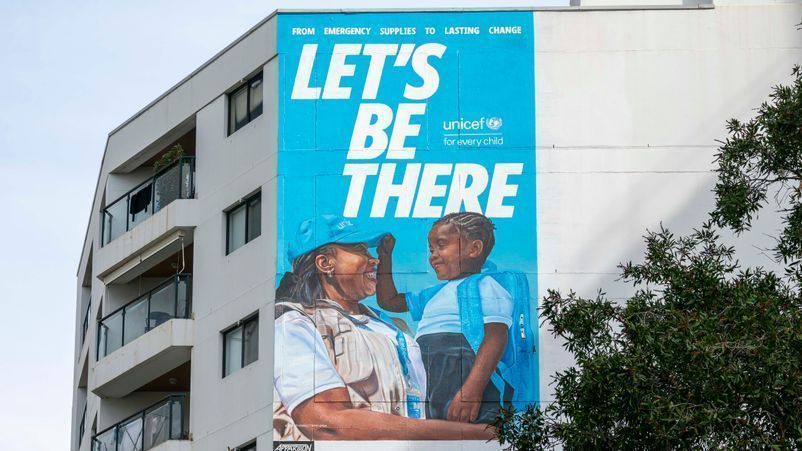
OOH

Result
5.2k views of Facebook launching content
1,529 views for the donation page launch video on Instagram
Conclusion
Despite being a large organisation with a long history of children advocacy work based on UN principle, “Let’s be there” campaign has allowed the brand to strengthen their position by shifting the public awareness of the Australian public on children work in general.


Comments